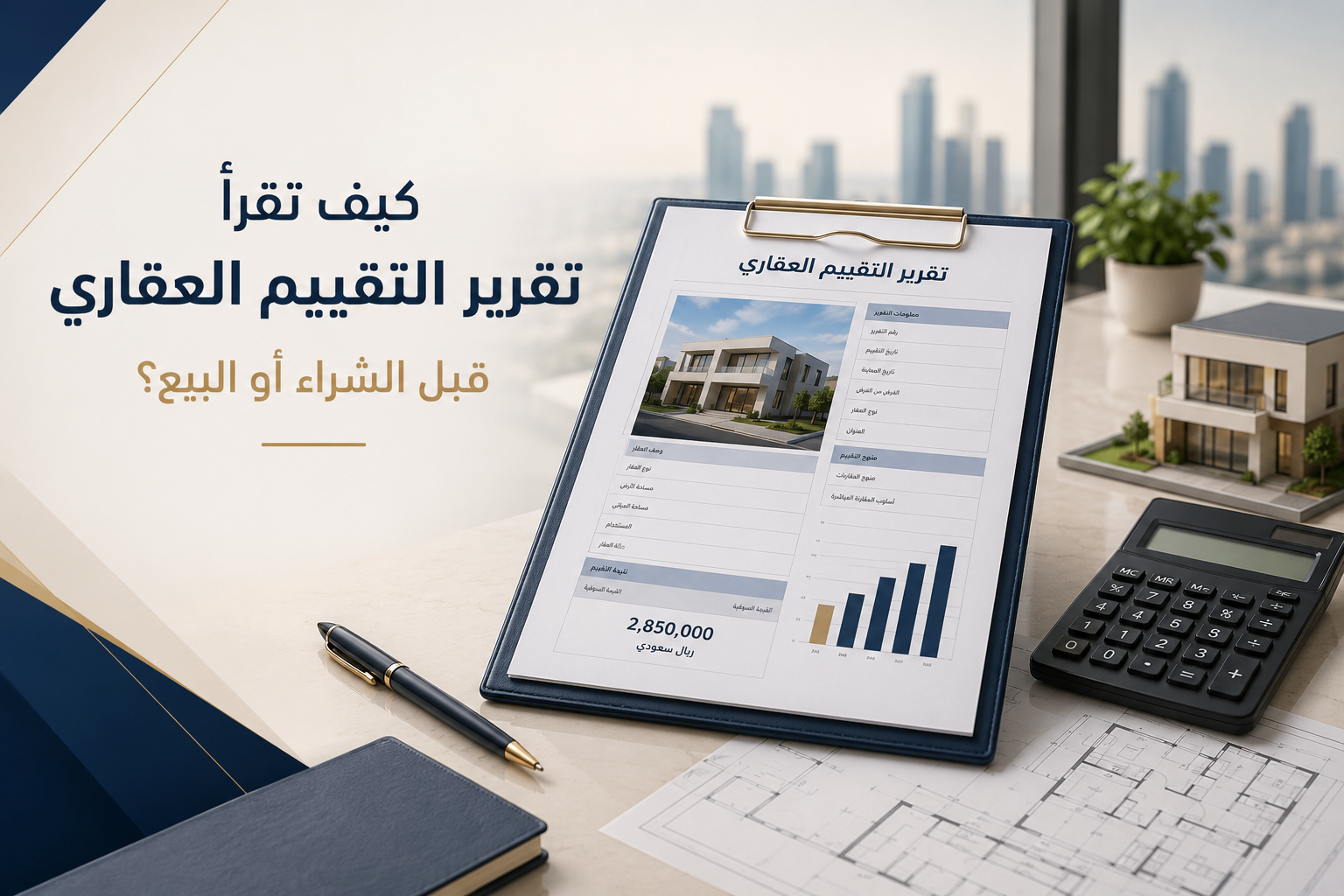
A property valuation report is not just a number at the end of the page. It is a professional document that helps you understand the value of a property at a specific time, for a specific purpose, and based on clear data and methodology. Therefore, reading the report correctly can make a big difference between a well-informed real estate decision and a hasty one.
In the Saudi market, owners, buyers, and investors need property valuation in many situations, such as selling, buying, mortgage financing, pledging, settling partnerships, exiting a real estate asset, or conducting an investment feasibility study. But the problem is that many focus only on the final value and ignore the details that may be more important than the number itself.
In this article, we explain how to read a property valuation report, what items to pay attention to, and when you need to ask the appraiser for clarification before basing your decision on the report.
What is a Property Valuation Report?
A property valuation report is a professional document that presents the appraiser's opinion of the value of a specific property, according to a specific purpose, on a specific date, and based on a methodology appropriate to the nature of the property and the market.
The Saudi Authority for Accredited Valuers (Taqeem) defines real estate valuation as the art and science of estimating the value of real property rights for a specific asset, for a specific purpose, at a specific time, and for specific users, taking into account the property's characteristics and the fundamental economic factors of the market.
This definition is important because it clarifies that property valuation is not a general estimate or a quick opinion, but a process linked to a clear context. The value of a property for sale may differ in its approach from its valuation for financing, dispute, or investment exit purposes.
Why Is It Not Enough to Look Only at the Final Value?
A common mistake is that a client opens the valuation report, looks for the final number, and then bases their decision directly on it. This is incomplete because the final value cannot be understood in isolation from the rest of the report.
The value may be based on certain assumptions. The report may be tied to a specific date after which market conditions changed. There may be reservations that affect the use of the report. The purpose of the valuation may not suit the decision you want to make.
For example, if a valuation report is issued for mortgage financing purposes, it may not necessarily be appropriate to use it as is for pricing the property for sale in the open market without understanding the report's scope and limitations. Similarly, if the report is relatively old, it may not reflect changes in the market or changes in the property's condition or surrounding area.
Therefore, correct reading starts from understanding the report as a whole, not just the final number.
First: Review the Purpose of the Valuation
The first item you should look for in the report is the purpose of the valuation.
Ask yourself: Why was this report prepared? Is the purpose selling? Buying? Financing? Mortgage? Division among heirs? Legal dispute? Investment study? Inclusion of an asset in financial statements?
The purpose affects how the report is prepared, the type of value required, the level of detail, and the appropriate methodology. A valuation prepared for financing purposes may focus on different considerations than a report prepared for an investor wanting to know the feasibility of buying a leased commercial property.
If the purpose stated in the report does not match your current use, do not treat the final value as suitable for all cases. It is better to ask the report preparer for clarification or request a new report tailored to the required purpose.
Second: Pay Attention to the Valuation Date
Property values are not fixed. They may change due to market movement, changes in land prices, completion of a nearby infrastructure project, changes in demand in the neighborhood, new regulations and requirements, or improvement or decline in the property's condition.
Therefore, you should review in the report:
Inspection date.
Valuation date.
Report issuance date.
These dates are not mere formalities. The property may be inspected on a certain day, but the report is issued later. The estimated value may be tied to a specific date, not the date you read the report.
If you are reading a report issued several months ago, do not assume the value is still accurate. In active markets, it may be necessary to update the valuation or request a new professional opinion, especially if the decision involves a large amount, financing, or a final transaction.
Third: Verify the Description of the Property Being Valued
One of the most important sections of a valuation report is the property description. This section should clarify exactly what was valued.
Review the following data carefully:
Item | Why It Matters |
|---|---|
Property Location | Because location is one of the strongest factors affecting value |
Property Type | Land, villa, apartment, building, showroom, office, warehouse |
Area | Any error in area may significantly change the value |
Use | Residential, commercial, administrative, industrial, mixed |
Property Condition | New, average, needs maintenance, occupied, vacant |
Frontages and Streets | Affect attractiveness, use, and value |
Surrounding Services | Schools, roads, shopping centers, transport, facilities |
Ownership and Restrictions | Any rights or obligations that may affect value |
If you find that the property description is inaccurate, or that an important element is not mentioned, you should pause before relying on the report. Valuing a property with an incomplete description may lead to an inappropriate result.
A simple example: A plot on two streets is not like a plot on one street. A fully renovated villa is not like a villa that needs major maintenance, even if they are in the same neighborhood and have a similar area.
Fourth: Understand the Type of Value Mentioned in the Report
Not all property values are the same type. In many cases, people talk about "property value" as if it is a fixed meaning, while the type of value may differ depending on the purpose.
The most common type that usually matters to the reader is market value, which is the value expected to be achieved in the market between a willing buyer and seller with adequate knowledge and without undue pressure on either party.
However, other types of values may appear in some reports, depending on the purpose, such as investment value, insurance value, accounting value, or others.
Therefore, do not just know the number. Ask: What type of value is mentioned? Is this type suitable for my decision?
If you want to sell a property in the market, market value is most relevant to your decision. If the report is for another purpose, you may need deeper reading or a request for a customized report.
Fifth: Review the Valuation Methodology Used
A good valuation report does not just state the value; it explains how it was reached. One of the most important things to review is the valuation methodology.
Commonly used methodologies in property valuation include:
1. Market Approach
Relies on comparing the property to similar properties that have been sold or listed in the market, with adjustments for differences in location, area, condition, use, frontage, and services.
This approach is common for valuing land, villas, apartments, and properties with sufficient market comparables.
2. Income Approach
Relies on the expected income from the property, such as rents, then converts this income into value using appropriate indicators. It is often used for investment properties such as showrooms, offices, leased buildings, shopping centers, and warehouses.
3. Cost Approach
Looks at the cost of constructing or replacing the property, considering depreciation and obsolescence factors. It is used in certain cases, especially when market comparables are limited or when the property has a special nature.
The reader is not required to become a property appraiser, but it is important to understand why this particular methodology was chosen. If the property is income-producing and investment-grade, it is natural for income to play a major role in the analysis. If the property is a residential plot in an active neighborhood, market comparables may be more prominent.
Sixth: Examine the Market Comparables
If the report uses the market approach, you will usually find a section dedicated to comparables. This section is very important because it reveals the strength of the analysis.
When reading the comparables, pay attention to the following questions:
Are the comparables in the same neighborhood or a similar area?
Is the property type similar to the property being valued?
Are the areas close?
Are the comparables recent or old?
Are they actual transactions or just listed offers?
Are the differences between the property and the comparables explained?
Were logical adjustments made to the prices?
Not every comparable is valid. Comparing an interior villa to a villa on a commercial street may be misleading. Comparing a plot in a fully serviced scheme to a plot in a less ready area may give an inaccurate result.
The closer the comparables are to the property in location, characteristics, and timing, the more reassuring the reading. If the comparables are distant or unclear, you have the right to ask for an explanation.
Seventh: Read the Assumptions and Reservations Carefully
The assumptions and reservations section is one of the most overlooked sections by non-specialists, even though it may be one of the most important parts of the report.
Assumptions are matters on which the valuation is based, such as assuming the validity of documents, the property being free from hidden structural problems, the accuracy of provided areas, or the absence of undisclosed regulatory restrictions.
Reservations may define the limits of the report's use, alert to information that has not been verified, or conditions that may affect the value.
Example: If the report assumes the property is free from disputes or restrictions, and later a regulatory problem or significant obligation appears, the entire reading of the value may change.
Therefore, do not treat assumptions as marginal legal language. Read them as an essential part of understanding the final number.
Eighth: Differentiate Between Price and Value
One of the most confusing points in the real estate market is mixing up price and value.
Price is the amount the seller asks for or accepts in a particular transaction. It may be influenced by personal factors, such as the seller's need for liquidity, the buyer's urgency, negotiation skills, or special circumstances of the deal.
Value in a valuation report is a professional opinion based on a systematic analysis of available data, according to a specific purpose and date.
You may find a property listed at a price higher than its market value, and that does not mean the report is wrong. A transaction may occur at a price lower than the estimated value due to negotiation circumstances or an urgent need to sell.
Therefore, use the valuation report as a tool to understand the decision, not as a complete substitute for negotiation or studying the transaction's circumstances.
Ninth: Link the Valuation Result to Your Actual Decision
After reading the report, ask yourself: What does this value mean for my decision?
If you are a buyer, the report helps you know whether the asking price is reasonable compared to the property's characteristics and the market. But it does not replace inspecting the property, verifying documents, and studying your financing capacity.
If you are an owner, the report helps you price the property more realistically, instead of relying on advertised prices or expectations not based on data.
If you are an investor, the report gives you an important starting point, but you should also read the expected return, occupancy rates, operating expenses, tenant quality, and area risks.
If the valuation is for financing purposes, read the report in light of the financing entity's requirements, as banks and financing institutions may require reports according to specific controls and procedures.
Tenth: When to Ask the Appraiser for Clarification?
Do not hesitate to ask for clarification if you find an unclear point in the report. A professional valuation report should be clear enough for its intended user.
Ask for clarification in the following cases:
If you do not understand why a particular valuation methodology was chosen.
If the comparables are unclear or far from the property.
If you find a large difference between the value and the asking price.
If there are significant assumptions whose meaning you do not understand.
If the purpose of the report does not match your use.
If the property data is inaccurate.
If the property's condition or the market has changed since the report date.
If the financial decision is large and requires a higher degree of confidence.
Asking here does not mean doubting the report, but rather using it correctly.
Common Mistakes When Reading a Property Valuation Report
1. Focusing Only on the Final Number
The final value is important, but it is the result of a complete analysis. Ignoring details may lead to a misunderstanding of the report.
2. Comparing the Valuation Only to Advertised Prices
Advertised prices do not always mean actual selling prices. Some properties are listed at higher prices for negotiation or to test the market.
3. Ignoring the Report Date
An old report may not reflect the current market situation, especially in areas experiencing urban changes or shifting demand.
4. Using the Report for a Different Purpose
A report prepared for a specific purpose is not always suitable for another purpose. You must ensure the purpose matches your decision.
5. Neglecting Reservations and Assumptions
Assumptions may contain points that affect the understanding of the value. Ignoring them may give you excessive confidence in a number that needs conditional reading.
6. Assuming the Valuation Guarantees a Sale at the Same Value
The valuation estimates the value based on specific data, but it does not guarantee the transaction will occur at that same value. Market, negotiation, and timing are influencing factors.
A Simple Practical Example
Suppose you have a villa in North Riyadh, and you receive a valuation report estimating its value at a certain amount. Before relying on the number, you must ask:
Are the comparables from the same neighborhood or only nearby areas?
Are the comparable villas of the same age and condition?
Was the impact of the frontage or street width considered?
Is the finishing and maintenance condition similar?
Is the report recent?
Is the purpose of the valuation selling or financing?
Are there assumptions about the building's integrity or documents?
These questions may change how you understand the value. The number may be very reasonable if the comparables are accurate and recent, and it may need discussion if the data is insufficient or the property has special characteristics not clearly shown in the report.
How Does a Valuation Report Help You in Selling?
If you are an owner thinking of selling your property, a valuation report helps you set a more realistic price. Overpricing may prolong the property's time on the market, while underpricing may cause an unjustified loss.
A good report gives you a better understanding of your property's position relative to the market and helps you negotiate with confidence, especially when the value is based on clear comparables and methodology.
However, note that the valuation does not necessarily mean the sale will happen immediately at that same value. The speed of sale depends on demand, marketing, how the property is presented, negotiation flexibility, and market conditions at the time of sale.
How Does a Valuation Report Help You in Buying?
If you are a buyer, the report helps you test the reasonableness of the asking price. The property may be attractive in terms of location or design, but its price is higher than market indicators. Or the price may be appropriate, but there are reservations or factors that need additional inspection.
Reading the report helps you negotiate, set an appropriate price ceiling, and understand whether there are factors justifying the price, such as location, frontage, construction quality, proximity to services, or scarcity of supply in the area.
However, do not make the valuation report the sole basis for your purchase decision. Combine it with a technical inspection, verification of the deed and documents, study of obligations, and understanding of financing requirements if any.
How Do You Know the Report Is Clear and Professional?
Not every long report is necessarily a good report. A professional report is characterized by clarity, coherence, and ease of following the logic that led to the value.
If you want to ensure the report is from a reliable source and adheres to professional standards, you can read our guide on Verifying the Reliability and Accuracy of Property Valuation, which explains the key signs that help you assess the quality of the report and the preparer.
Signs of a good report include:
Clearly defines the purpose of the valuation.
States the valuation and inspection dates.
Describes the property accurately.
Explains the methodology used.
Presents appropriate data and comparables.
Clarifies assumptions and reservations.
Distinguishes between value and price.
Provides an understandable result supported by analysis.
Adheres to the limits of use and intended users.
Beneficiaries in Saudi Arabia can also benefit from the services of the Saudi Authority for Accredited Valuers, such as inquiring about licensed valuation firms or submitting a valuation request through the "Qayyim" platform, as provided by the authority in its electronic services.
Frequently Asked Questions About Reading a Property Valuation Report
Is the valuation value the same as the selling price?
Not necessarily. The valuation value is a professional opinion based on data and methodology, while the selling price is what is actually agreed upon between the buyer and seller. They may match, or they may differ depending on market conditions and negotiation.
Can I rely on an old valuation report?
It depends on the report date, market conditions, and the purpose of use. If a long time has passed, or market conditions or the property's condition have changed, you may need to update the valuation.
What should I do if the valuation is lower than the asking price?
Do not rush to reject the property or accept the price. Review the comparables, methodology, and property condition, then use the report as a negotiation tool. You may need a second opinion if the difference is large.
Does a valuation report reveal structural defects?
A valuation report is not a substitute for an engineering or specialized technical inspection. It may indicate the general condition of the property, but it does not replace a technical inspection if the decision requires it.
Do I need a certified appraiser?
When there is an important financial or legal decision, or when dealing with a financing or official entity, dealing with a licensed valuation firm or certified appraiser increases the report's reliability and reduces risks.
Article Summary
Reading a property valuation report does not mean just looking for the final number. A good report tells the property's story: What is the purpose of its valuation? When was it valued? What are its characteristics? What methodology was used? What are the comparables? What are the assumptions? And what are the limits of using the result?
The more you understand these elements, the more capable you become of making an informed real estate decision, whether you are buying, selling, financing, investing, or managing a property asset.
In a changing real estate market like the Saudi market, relying on impressions or advertised prices is not enough. The best decision starts with clearer data, professional valuation, and a conscious reading of what the report says and what it does not say.
If you need a property valuation report to help you understand your property's value and make a clearer decision, you can benefit from property valuation services at HBS Real Estate Valuation to obtain a professional report based on a clear methodology and appropriate market reading.
System Admin
مقيّم عقاري معتمد — Haifa Bin Saedan Real Estate Valuation
Frequently Asked Questions
The purpose of the valuation and the intended user. The purpose determines the basis of value, the approach and the level of detail, so a report prepared for financing does not necessarily suit sale pricing. If it does not match your use, ask for clarification or a new report.
Because the value is tied to an inspection date, a valuation date, and the assumptions and limiting conditions stated in the report. A market or property change after that date, or an assumption that did not hold, changes what the figure means. Read the dates, assumptions and comparables first.
When the purpose does not match your use, the dates are old, an assumption is unclear, a limiting condition restricts use, or the comparables do not resemble your property in location or size. Asking before the decision costs far less than correcting it afterwards.